
Description
PrymaLab · Research Use Only
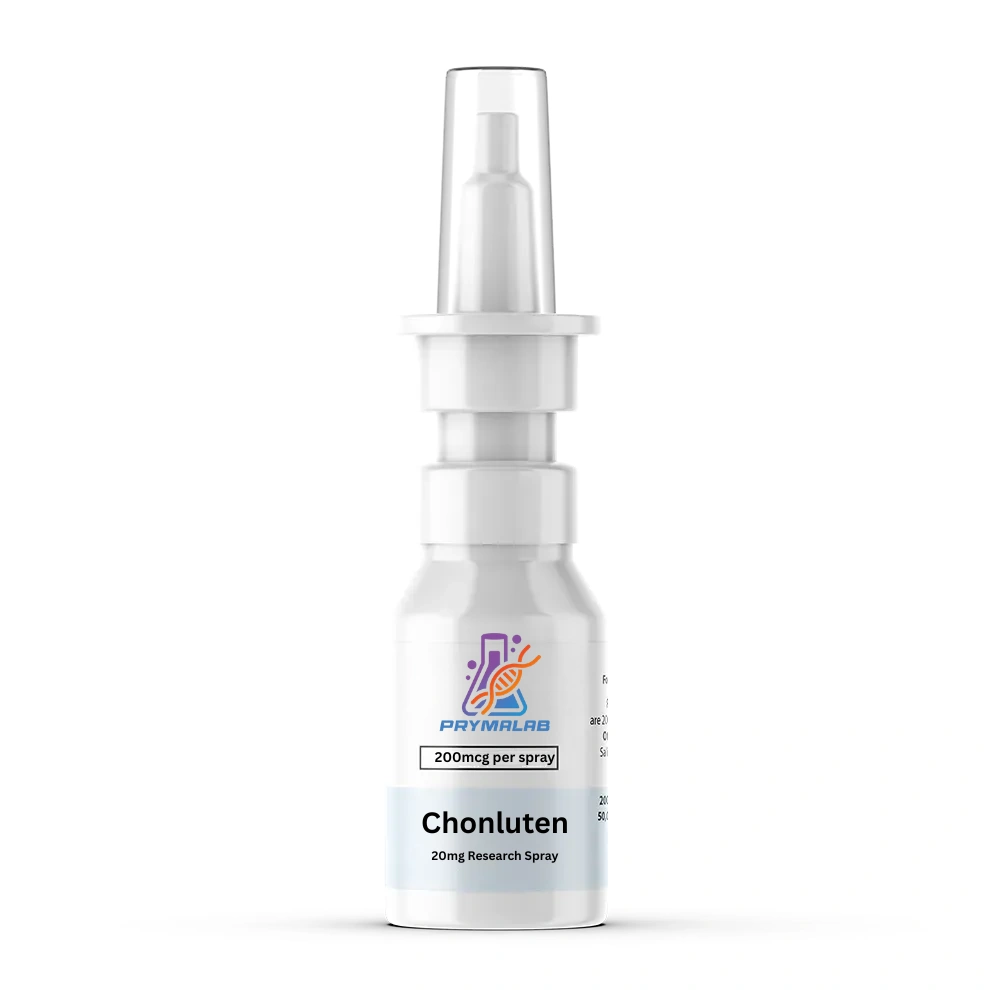
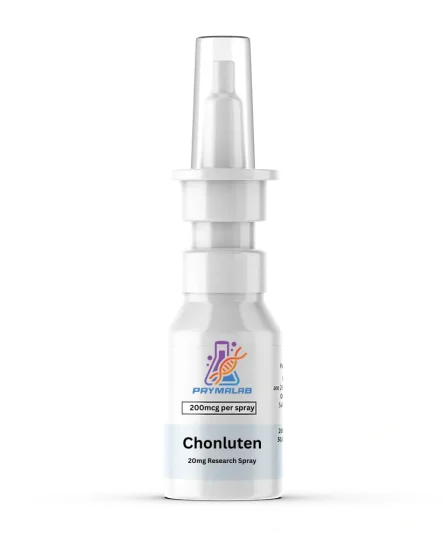
Chonluten Nasal Spray
Glu-Asp-Gly tripeptide · 319.3 Da · carries an Asp-Gly motif
Chonluten nasal spray supplies the tripeptide Glu-Asp-Gly in a metered aqueous solution at roughly 319.3 daltons. Two of its three residues form an aspartate-glycine pair, which is among the most reactive arrangements in peptide chemistry and the reason a solution-state format matters more here than for most of this family.
Specification Table
| Property | Value |
|---|---|
| Compound | Chonluten |
| Sequence designation | EDG |
| Amino acid sequence | Glutamate-Aspartate-Glycine |
| Sequence provenance | Secondary sources, converging. Not traced to a single primary citation. Confirm against the lot certificate before relying on it for calculation |
| Residue count | 3 |
| Molecular weight, calculated | Approximately 319.3 g/mol, computed from standard residue masses plus water |
| Labile motif | Asp-Gly at positions 2 and 3 |
| Principal solution-state reaction | Succinimide formation, opening to aspartate or isoaspartate |
| Mass change on isomerisation | None. The rearranged product is isobaric with the parent |
| Net charge at neutral pH | Negative. Two acidic residues, no basic residue |
| Chromophore | None. Concentration cannot be determined by 280 nm absorbance |
| Oxidation-prone residues | None |
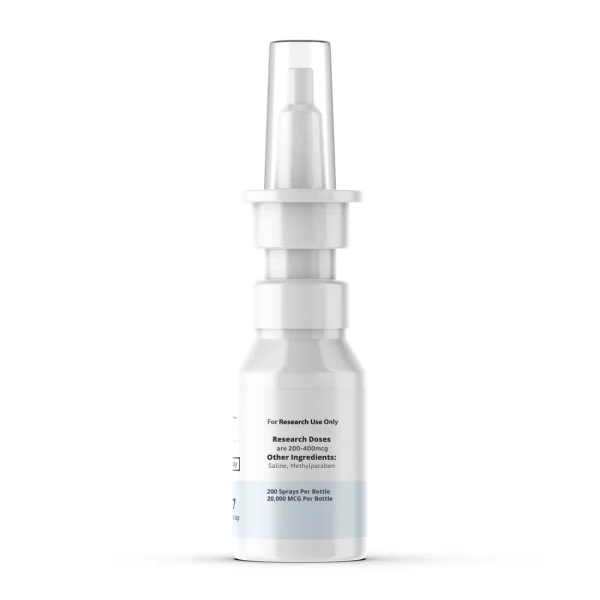
| Format | Metered nasal spray, solution state |
| Physical state | Aqueous solution, supplied ready to use |
| Purity | Per lot-specific certificate of analysis |
| Storage | 2-8°C, protected from light. Do not freeze |
| Regulatory status | No approved human or veterinary formulation in any jurisdiction |
Why Does the Asp-Gly Motif Matter in Chonluten Nasal Spray?
Aspartate followed by glycine is a specific sequence that peptide chemists watch for. This compound carries it at two of its three positions.
The aspartate side chain can attack the backbone nitrogen of the residue that follows it, closing a five-membered succinimide ring and expelling water.
Glycine is the residue that permits this most readily, because it has no side chain to obstruct the geometry the reaction requires.
That ring is unstable and reopens, but it can reopen two ways. One gives back aspartate. The other gives isoaspartate, where the backbone runs through the side-chain carboxyl instead.
Isoaspartate is a structurally different molecule. The chain is one carbon longer through that residue and the shape changes accordingly.
For a three-residue peptide that is not a subtle modification. Roughly a third of the molecule has been rearranged.
The reaction needs water, which means a lyophilized powder is largely protected and an aqueous solution is not.
That is the whole case for understanding this compound differently in a spray than in a vial, and it is a chemical argument rather than a commercial one.
Why Is This Degradation Silent?
The rearrangement produces a molecule with the same atoms in a different arrangement, which defeats the standard analytical panel.
Isoaspartate and aspartate are isomers. Same formula, same exact mass, same nominal mass.
Mass spectrometry therefore cannot distinguish them at any resolution, which is unusual since resolution normally solves this kind of problem.
The succinimide intermediate itself is 18 daltons lighter, having lost water, so a species near 301 would indicate the reaction caught mid-course. That intermediate is short-lived and rarely accumulates.
Chromatographic separation is possible but not guaranteed, since the structural change is modest and retention may shift very little under a routine gradient.
A dedicated method exists. Protein isoaspartyl methyltransferase recognises isoaspartate specifically and can be used as the basis of an assay.
Almost nobody runs it on a commercial research peptide, which means a certificate stating high purity has not addressed this question at all.
The honest position is that elapsed time in solution is the practical proxy for isomerisation, because the direct measurement is available in principle and absent in practice.
It is worth being precise about what a rearranged molecule is, because loose language here causes real confusion.
An isomerised molecule is not a fragment and nothing has been lost. Every atom present at the start is still present at the end.
What has changed is where the backbone runs through the second residue, which alters the shape without altering the composition.
For a molecule whose proposed mechanism depends on sequence-specific recognition, a shape change of that kind is not obviously a minor one.
What Follows for a Solution-State Format?
If the principal degradation route is invisible and time dependent, then the handling advice has to change shape.
For most products the instruction is to store correctly and check the certificate. Here the certificate describes the material at fill. It says nothing whatever about the material at the moment somebody uses it.
Date the bottle when it is opened. More importantly, find out when it was filled, because the manufacturing date carries more information for this compound than it does for anything else in the bioregulator range.
A supplier unwilling to state a fill date is withholding the one number that bears on the question.
The reaction is pH sensitive and accelerates under alkaline conditions. So a periodic pH check on an opened bottle is worth running.
Temperature matters in the ordinary way, which is the argument for refrigeration rather than ambient storage even though nothing visibly changes either way.
Where an experiment spans months, using a fresh bottle for the later arms rather than the same bottle throughout removes a variable that cannot be measured afterwards.
That is an unusual recommendation and it follows directly from the chemistry rather than from a desire to sell more bottles.
One further point applies to how a study using this compound should be reported rather than run.
Where a result is published, stating the fill date and the elapsed time in solution alongside the lot number costs one sentence in the methods.
That single sentence is what would let a later group reproduce the work under comparable conditions rather than guessing.
It is standard in regulated pharmaceutical work and almost unknown in the research peptide market. That is a gap worth closing regardless of compound.
How Does the Truncation Relationship Read in a Spray?
This compound has a structural relationship to another product in the catalogue, and the format changes what that relationship implies.
Epitalon is Ala-Glu-Asp-Gly. Remove the alanine and this compound is exactly what remains.
For a powder, that relationship raises a manufacturing question about whether a failed final coupling on an Epitalon batch produced this compound instead.
For a solution, the question is narrower and cleaner. Truncation happens during synthesis, not in the bottle, so the answer was fixed before the product was filled.
That means the check belongs entirely to the certificate and cannot be repeated by the buyer at the point of use, since the buyer has no powder to weigh or re-analyse.
The masses differ by roughly 71 daltons, putting Epitalon near 390.35 against roughly 319.3 here, which any mass spectrometer resolves.
Asking whether the fill-time analysis looked for a species near 390 is therefore worth doing once, before the material is committed to a study.
A solution-state format concentrates that kind of question into a single point in time, which is a real difference from a powder the buyer can re-examine.
How Does 319 Daltons Affect the Nasal Route?
This compound sits at the favourable end of the size range, among the smallest molecules in this spray catalogue.
Transport across the nasal epithelium falls away sharply as molecules grow, and somewhere near 1,000 daltons the route between cells stops carrying useful quantities.
At roughly 319.3 daltons this compound is far below that boundary, close to glutathione at 307.32 and to Thymogen at roughly 333.35.
Size is therefore not the obstacle, which narrows the transport question to charge and to surface chemistry.
Two acidic residues with no basic residue give a clearly negative net charge at physiological pH, and an anion is not held by a negatively charged mucosal surface.
That reduces mucoadhesion relative to the cationic peptides in this range, which means less retention at the surface as well as less obstruction to transit.
The nasal route for this compound appears in no published study at all, which leaves the transport argument resting on structure rather than measurement.
What Does the Respiratory Claim for Chonluten Rest On?
This compound is sold throughout the market as a lung bioregulator, and that description is worth examining rather than repeating.
The originating programme at the St. Petersburg Institute of Bioregulation and Gerontology, directed by Vladimir Khavinson, assigned each short peptide bioregulator to an organ. This synthetic tripeptide, listed in some sources as tripeptide T-34, was assigned to the respiratory system.
The assignment came from the tissue the original peptide extract was drawn from rather than from any measured affinity for lung tissue.
That distinction matters. An extract sourced from bronchial tissue is not the same as a molecule shown to act on it.
What the programme reported in aged and injured rodents is histological change in pulmonary tissue, alongside shifts in markers of gene expression read out from the bronchi, the bronchial mucosa included.
Markers named across that body of work include c-Fos, HSP70, COX-2 and TNF-alpha, and the general shape of the finding is reduced inflammatory signalling with increased expression of antioxidant and anti-inflammatory proteins.
Superoxide dismutase appears in the same discussions, since SOD activity is the usual proxy for antioxidant activity against reactive oxygen species.
Reduced oxidative stress in respiratory tissue is the mechanism quoted most often for this compound. It is a hypothesis supported by marker data from one programme, not a demonstrated pathway.
Chronic bronchitis, asthma and COPD are named in secondary summaries of that work. No adequately powered trial in any of those conditions exists, and this compound is not a treatment for any of them.
Effects on mucus production, on mucosal function and on the respiratory epithelium are asserted widely across vendor pages. The primary record does not contain the measurements those assertions would need.
The same pages call it a respiratory bioregulator and attach broad respiratory health language to it. Neither phrase appears in the primary record, and neither is a claim this product makes.
The family-wide hypothesis is that these peptides bind DNA and alter chromatin state, with DNA methylation and apoptosis both discussed as downstream readouts. No receptor has been named and no binding constant published.
One further point about scope. The same programme reported findings for this tripeptide in the gastrointestinal tract as well as in the lung, which sits awkwardly beside a strictly organ-specific account of how these molecules are supposed to work.
That inconsistency is in the source material rather than in the summarising of it, and pointing at it is more useful than smoothing it over.
What Research Position Applies?
The published record for this compound is among the thinnest in a family whose record is thin throughout.
The St Petersburg programme published aged-rodent observations read out histologically and through markers of tissue-associated gene expression.
Those studies were parenteral throughout. Nothing in print describes this compound reaching tissue by the nasal route.
Family-wide cell-culture work on chromatin decondensation supports the DNA-binding hypothesis rather than any tissue-specific claim for this compound.
The mechanism is still a hypothesis, never independently established outside the originating programme, with no receptor named and no binding constant published.
The bioregulator range as a whole has never been through an adequately powered independent Western trial. This compound is no exception.
Anyone expecting a substantial primary literature for this particular member of the family will not find one, and saying so is more useful than padding the section.
Where Does Chonluten Peptide Sit Among the Others?
A short peptide bioregulator is only interpretable against its neighbours, and this catalogue stocks enough of them for the comparison to be real.
Cartalax is Ala-Glu-Asp-Gly, the same four residues as Epitalon in the same order, which makes the naming in this family less orderly than it looks.
Ovagen is Glu-Asp-Leu and Cortagen is Ala-Glu-Asp-Pro. Both replace the terminal glycine that gives this compound its instability, and both last longer in water for exactly that reason.
Cardiogen is the only cationic member and Livagen sits near neutral, so charge across the family varies more than mass does.
Against that group this is the smallest and the least stable in solution, which is a chemical distinction rather than a marketing one.
Outside the family, the two peptides shelved beside it most often are BPC-157 and GHK-Cu. Neither is a bioregulator and neither shares its proposed mechanism.
Oxytocin turns up in the same nasal spray conversations because it is the one short peptide with substantial published intranasal data. That data belongs to oxytocin and transfers to nothing here.
Clinics offering peptide therapy group all of these together. Research peptides sold for laboratory work are not grouped that way, and that distinction is the one that matters on this page.
Does Chonluten Nasal Spray Need Reconstitution?
No. Chonluten nasal spray is supplied as a metered aqueous solution, so there is no lyophilized powder to dissolve and no bacteriostatic water to add.
Where the compound is sold as Chonluten (20mg) in a vial, reconstitution is the buyer’s job and the resulting concentration is the buyer’s number. Here it is not.
That removes a common source of error and introduces the Asp-Gly problem described above, which is the trade this format makes.
Because bac water is never added, no preservative decision passes to the buyer either, and the fill is whatever the manufacturer states it to be.
Which puts more weight on the COA than a powder product would ask it to carry.
A certificate of analysis for this compound should state the amino acid sequence explicitly, since the trade name carries no chemical information and several bioregulators sit close in mass.
It should state the measured mass against the calculated one. The average mass computes to 319.27 g/mol, quoted as approximately 319.3 in the table above, and those are the same number written to different precision.
Mass spectrometry confirms that figure and, as set out above, cannot detect the isomerisation that is this compound’s real degradation route.
So a certificate of analysis here is necessary and not sufficient, and asking for the fill date alongside it is the part most often skipped.
Dosing protocols circulate for this compound across forums and clinic pages. None derive from a published human study, and this product is not for administration to humans or animals under any protocol.
The regulatory status is unchanged by the format. No approval exists anywhere, for the nasal route or for any other.
How Should Chonluten Nasal Spray Be Stored and Recorded?
Storage advice here is unusual because the reaction being guarded against produces no visible or measurable signal.
Keep the bottle refrigerated at 2 to 8 degrees Celsius, away from light, and out of the freezer.
There is no cysteine, methionine or tryptophan, so oxidation and photodegradation routes do not apply and light protection is a precaution rather than a requirement.
The Asp-Gly rearrangement is the reaction that actually proceeds. It is temperature and pH dependent rather than light dependent.
A periodic pH check is more informative than a visual inspection, since a solution drifting alkaline isomerises faster and looks identical either way.
Because the failure mode is silent on appearance, on nominal mass and on exact mass, elapsed time in solution is the only practical variable to control.
Record six things. The lot, the fill date if the supplier will state it, the date first opened, the storage temperature, the pH where it was measured, and the actuation count.
The fill date is the field that matters most here and the one most often absent, which makes it worth asking for explicitly rather than hoping it appears.
Published Literature
Selected references. The bioregulator literature originates almost entirely from one research programme and used parenteral routes.
- (‘Geiger T, Clarke S. Deamidation, isomerization, and racemization at asparaginyl and aspartyl residues in peptides. J Biol Chem. 1987;262(2):785-794.’, ‘https://doi.org/10.1016/S0021-9258(19)75855-4’)
- (‘Khavinson VK, Malinin VV. Gerontological Aspects of Genome Peptide Regulation. Basel: Karger; 2005.’, ‘https://doi.org/10.1159/isbn.978-3-318-01193-6’)
- (‘Reissner KJ, Aswad DW. Deamidation and isoaspartate formation in proteins. Cell Mol Life Sci. 2003;60(7):1281-1295.’, ‘https://doi.org/10.1007/s00018-003-2287-5’)
Frequently Asked Questions
What is Chonluten nasal spray?
A metered aqueous solution of the tripeptide Glu-Asp-Gly at roughly 319.3 daltons. Supplied for laboratory research only. It holds no human or veterinary approval anywhere.
What is the Asp-Gly motif?
Aspartate followed by glycine, one of the most reactive arrangements in peptide chemistry, and the aspartate side chain attacks the following backbone nitrogen, closing a succinimide ring and expelling water.
Why does glycine permit it?
Because it has no side chain to obstruct the geometry the reaction requires. Bulkier residues at that position slow the reaction considerably.
What does the ring produce?
It reopens two ways. One returns aspartate; the other gives isoaspartate, where the backbone runs through the side-chain carboxyl and the chain is one carbon longer through that residue.
Why is that significant here?
Because on a three-residue peptide roughly a third of the molecule has been rearranged. On a longer peptide the same event would be a minor local change.
Why can mass spectrometry not detect it?
Because isoaspartate and aspartate are isomers with the same formula and the same exact mass, and no resolution separates them, which is unusual since resolution normally solves this kind of problem.
Is there any method that works?
Protein isoaspartyl methyltransferase recognises isoaspartate specifically and can form the basis of an assay. Almost nobody runs it on a commercial research peptide.
What follows for handling?
Elapsed time in solution becomes the practical proxy for degradation, and the fill date carries more information for this compound than for anything else in the bioregulator range.
Does the format change the chemistry?
Yes. The reaction needs water, so a lyophilized powder is largely protected and an aqueous solution is not. That is a chemical argument for the vial where an experiment needs a defined starting material.
What is the truncation relationship?
Epitalon is Ala-Glu-Asp-Gly, so removing its alanine gives this compound. In a solution format that check belongs entirely to the fill-time certificate, since the buyer has no powder to re-analyse.
How does its size affect nasal transport?
At roughly 319.3 daltons it is among the smallest molecules in this spray catalogue, close to glutathione at 307.32. Size is not the obstacle; net negative charge and surface chemistry are the open questions.
Does Chonluten nasal spray need reconstitution?
No. It is supplied as a metered aqueous solution, so there is no lyophilized powder to dissolve and no bacteriostatic water to add. A vial of Chonluten (20mg) does require that step, and the resulting concentration is then the buyer’s number rather than the manufacturer’s.
Why is it called a lung bioregulator?
Because the St. Petersburg programme assigned each short peptide bioregulator to an organ, and this one was assigned to the respiratory system. The assignment came from the tissue the original extract was drawn from, not from measured affinity for lung tissue.
What markers does the respiratory work report?
c-Fos, HSP70, COX-2 and TNF-alpha appear across that body of work, with reduced inflammatory signalling and raised antioxidant activity as the general shape. Superoxide dismutase is the usual proxy. It is marker data from one programme, not a demonstrated pathway.
Is it a treatment for asthma or COPD?
No. Chronic bronchitis, asthma and COPD are named in secondary summaries of the rodent work. No adequately powered trial in any of those conditions exists, and this compound is sold for laboratory research only.
What should the certificate of analysis state?
The amino acid sequence explicitly, the measured mass against the calculated 319.27 g/mol, purity with the gradient stated, and the fill date. Mass spectrometry confirms identity but cannot detect the isoaspartate rearrangement, so a COA here is necessary and not sufficient.
Compliance Statement
Chonluten nasal spray is sold exclusively for laboratory research use. It is not a drug, food, or cosmetic product, and it is not a dietary product of any kind. It is not approved by the FDA or any comparable authority for human or veterinary use, its proposed mechanism has not been independently established, no published study characterises this compound delivered intranasally, and its principal solution-state degradation route produces a species that standard analysis cannot detect. This product is not intended to diagnose, treat, cure, or prevent any disease. It must not be given to humans or animals. Purchase is restricted to qualified researchers and institutions operating within applicable laws. All handling is the responsibility of the purchasing laboratory.
Other formats of Chonluten
Chonluten is also stocked as Chonluten Peptide 20mg and Chonluten 20mg preloaded 3ml pen. Each listing states its own quantity and concentration, and the pen and vial comparison explains what changes between formats.










5 reviews for Chonluten 20mg Nasal Spray